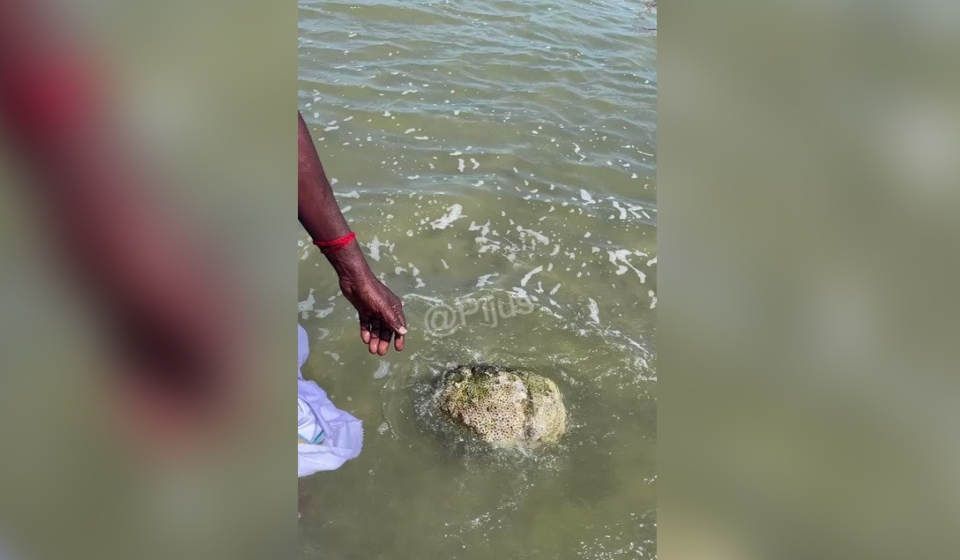
The Floating Stones of Rameswaram – What Is the Story Behind the Stones That Appear to Float?

Rameswaram, Tamil Nadu, is one of India’s most fascinating pilgrimage destinations. Along with the famous Ramanathaswamy Temple, the region is closely associated with the legendary Ram Setu, the bridge traditionally believed to have been built by Lord Rama and his army to reach Lanka.
Among the most intriguing stories connected with Rameswaram is that of stones that can float on seawater. For generations, these stones have attracted the curiosity of pilgrims, travellers and people interested in the history of the Ramayana.
But what is the story behind them? And what can science actually tell us?
The Story of Ram Setu
According to Hindu tradition, Lord Rama needed to cross the sea to reach Lanka in his search for Sita. The Ramayana describes the construction of a bridge across the sea with the help of his army.
The chain of shallow formations between Rameswaram and Sri Lanka is traditionally identified with this bridge and is known as Ram Setu or Rama’s Bridge. The same geographical feature is also known as Adam’s Bridge. It consists of a chain of shoals and limestone formations extending between India and Sri Lanka.
The Ramanathaswamy Temple and Rameswaram are deeply connected with this religious tradition. The Government of India’s tourism website also records the local belief that floating stones were associated with the construction of the legendary bridge.
Why Are Some Stones Said to Float?
This is where the story becomes particularly interesting.
Some stones displayed in and around Rameswaram are described as floating stones. Visitors have long been fascinated by the idea that an apparently ordinary stone can remain on the surface of water.
However, a stone floating in water does not automatically prove that it was used to construct Ram Setu.
From a scientific perspective, an object floats when its average density is lower than the liquid in which it is placed. Highly porous materials can contain significant amounts of air within their structure, reducing their overall density.
Therefore, the ability of a particular lightweight or porous stone to float can have a physical explanation.
Does the Original Ramayana Say That “Ram” Was Written on the Stones?
This is an important distinction.
The popular story that writing the name “Ram” on a stone makes it float is widely known in Indian religious tradition. However, this specific detail should not automatically be presented as a direct quotation from the earliest Valmiki Ramayana.
Different Ramayana traditions and later retellings contain variations of the story. The floating-stone version became particularly popular in devotional traditions.
So, for an informative article, it is better to say that this is a popular religious tradition, rather than claiming that modern demonstrations scientifically prove the Ramayana account.
What Is Ram Setu Scientifically?
There is a real geographical formation between southeastern India and northwestern Sri Lanka.
It is a chain of shallow-water formations, including shoals, sandbanks and limestone-related formations. Scientists have studied its geological history and formation.
The existence of this physical formation is not disputed. What remains a separate question is whether the formation was constructed by humans as described in the Ramayana.
Scientific evidence currently does not establish that the entire formation was a man-made bridge built by Lord Rama’s army. The Indian Express, after examining claims surrounding alleged scientific evidence, reported that there was no published peer-reviewed evidence establishing those claims.
Faith and Science Tell Different Stories
The most interesting part of Ram Setu is that it can be discussed from two different perspectives.
From the religious perspective:
Ram Setu is a sacred part of the Ramayana tradition and is deeply connected with Lord Rama, Sita and the journey to Lanka.
From the scientific perspective:
The formation is a real chain of shallow marine features whose geological history involves natural processes. Its exact history and development are subjects of scientific study.
These two perspectives should not be confused with each other.
Why Rameswaram Continues to Fascinate Visitors
Rameswaram is much more than the story of a floating stone.
The island contains the famous Ramanathaswamy Temple, Agni Theertham, Pamban Bridge and the historic region around Dhanushkodi. The Government of Tamil Nadu’s district website describes Rameswaram’s connection with the Ramayana and the local traditions surrounding Rama’s journey.
For visitors, the combination of mythology, geography, ocean scenery and history makes the region particularly unique.
The Mystery of the Floating Stone
Perhaps the best way to understand the floating-stone story is not to ask only, “Is it a miracle or science?”
Instead, ask a broader question:
How did a physical phenomenon become part of one of India’s most enduring religious traditions?
The stones, the sea between India and Sri Lanka, the Ramayana and centuries of pilgrimage have together created a fascinating cultural story.
A floating stone can be investigated through physics and geology. Its religious meaning, however, belongs to faith and tradition.
That distinction makes the story even more interesting.
Final Thoughts
The floating stones of Rameswaram remain one of the most fascinating stories associated with Ram Setu.
There is a real chain of shallow marine formations between India and Sri Lanka, and floating or lightweight stones can have physical explanations. At the same time, the belief that these stones were connected with Lord Rama’s bridge remains an important part of Hindu tradition.
The mystery is real as a cultural story—but claims about its supernatural or historical origin should be presented carefully unless supported by reliable evidence.
This article distinguishes between religious tradition and scientifically established information. It does not attempt to prove or disprove matters of faith.