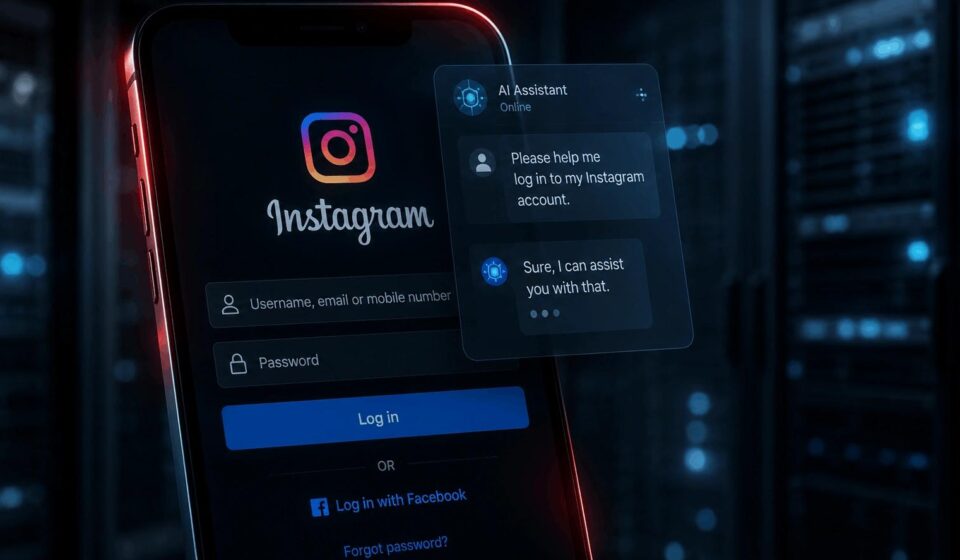

AI cybercrime and account takeover are becoming a serious concern as artificial intelligence becomes connected to social-media accounts, customer support systems and software development. A real 2026 incident showed how attackers could manipulate an AI-powered support system and use the process to target Instagram accounts. This AI cybercrime and account takeover risk raises an important question: what happens when an automated system trusts the wrong person?
The incident raises a much bigger question:
As companies give AI more power to solve problems automatically, are we also giving hackers a new way to manipulate those systems?
A Real 2026 Incident Involving an AI Support System
In June 2026, security researchers reported that attackers had abused Meta’s AI-powered support chatbot to help take over Instagram accounts.
According to TechCrunch, attackers reportedly manipulated the support chatbot into accepting claims of account ownership. In some cases, the system helped change the email address associated with targeted accounts. Once attackers controlled the recovery email, they could potentially take further steps to take over the account. Meta later said it had fixed the issue.
The incident became particularly interesting because some of the targeted accounts were notable or high-profile profiles.
Ars Technica also reported on the incident and the targeting of valuable Instagram usernames.
The important point is not simply that an Instagram account was compromised.
The bigger lesson is that an attacker may sometimes exploit the logic of an automated system instead of directly breaking through its security.
The New Meaning of “Hacking”
When most people hear the word hacking, they imagine someone stealing a password or installing malware.
Modern cybercrime can be much more complicated.
An attacker may exploit an API, manipulate an automated process, abuse an account-recovery mechanism, steal a session token or convince a system to perform an action that should have required stronger verification.
In other words, the attacker does not always need to break the door if they can convince the security system to open it.
That becomes especially important when AI is placed between the user and sensitive backend systems.
Why AI Changes the Security Equation
Traditional software normally follows rules created by developers.
AI systems can interpret language, evaluate context and generate responses dynamically.
That flexibility makes AI extremely useful. At the same time, it creates a new security challenge.
Suppose an AI support agent is allowed to help users recover accounts.
It may have access to identity information, account records and recovery functions.
Now imagine an attacker successfully convinces the AI that they are the legitimate account owner.
The AI makes a wrong decision.
The backend follows the AI’s instruction.
A conversation has suddenly become a security incident.
A Small Development Mistake Can Become a Big Attack
This is where software development becomes extremely important.
A developer may create a feature that looks completely normal during testing.
For example, the requirement might be:
“Allow genuine users to recover their accounts quickly.”
The developer builds the feature, tests several normal scenarios and confirms that everything works.
However, one question may have been missed:
“What happens if someone deliberately tries to fool the system?”
That missing test can become the attacker’s opportunity.
When a Bug Becomes a Human Problem
Developers often describe problems using technical terms such as bug, vulnerability or configuration error.
Users experience the consequences differently.
A small access-control problem could expose private messages, photographs, business information or financial details.
Consequently, the chain can become:
Small bug → Security weakness → Account takeover → Data loss → Real-world damage
For an ordinary person, losing a social-media account may mean losing years of memories.
For a creator or business owner, the same incident could affect customers, income and reputation.
Why AI-Generated Code Needs Human Review
AI can write code much faster than a developer working manually.
Nevertheless, generated code is not automatically secure simply because it compiles or passes a basic test.
A function may work correctly with normal input but behave dangerously when an attacker provides unexpected input.
Similarly, AI may generate authentication logic that appears reasonable but fails to properly verify permissions.
For this reason, developers should review AI-generated code before using it in production.
They should understand what the code does rather than simply copying the answer from an AI assistant.
The Danger of Sharing Production Data With AI
There is another risk that developers can easily overlook.
Imagine a developer receives a production error and wants AI to explain it.
They copy the entire log into an AI tool.
Unfortunately, that log contains a customer email address, internal API information, a session identifier or another confidential value.
The developer was trying to solve a bug.
Instead, sensitive information may have been unnecessarily exposed.
Therefore, developers should remove or mask confidential information before using real-world logs or code in AI prompts.
Never Paste These Secrets Into an AI Prompt
Developers should be particularly careful with:
- Passwords
- API keys
- Private keys
- Database credentials
- JWT secrets
- Production tokens
- Customer personal information
- Private source code
- Internal documents
- Authentication codes
- Confidential business information
Instead, replace real values with safe dummy data whenever possible.
For example, a real production password should never be included simply to help an AI explain a connection error.
AI Agents Need the Right Permissions
The risk becomes even greater when AI agents can perform actions instead of merely providing answers.
An AI coding agent might have access to a repository, terminal, browser, cloud environment or deployment system.
That can be extremely powerful.
However, unnecessary permissions increase the possible damage from a mistake, compromised environment or malicious instruction.
Therefore, organisations should follow the principle of least privilege.
If an AI only needs to read a file, it should not automatically receive permission to delete files.
Likewise, an AI working in a development environment should not automatically receive unrestricted production access.
Why “Fix It Later” Can Become Expensive
Security problems are often cheaper to fix during development than after release.
A vulnerability found before deployment may require a code change and another round of testing.
Once the same vulnerability reaches production, the situation becomes much more complicated.
The company may need to investigate the incident, identify affected users, analyse logs, deploy an emergency patch and monitor the system.
Moreover, the technical fix may not undo the damage that already occurred.
A database can be secured again.
A leaked password can be changed.
However, lost trust is much harder to recover.
Third-Party Packages Can Create Another Risk
AI may recommend a library because it appears to solve a programming problem quickly.
That does not mean the package should automatically be installed.
Before adding a dependency, developers should check whether it is trustworthy, maintained and necessary.
They should also look for known vulnerabilities and understand what permissions the package requires.
After all, an application can be secure at the source-code level and still become vulnerable through a compromised dependency.
What Developers Should Do Before Releasing AI-Assisted Code
A safer workflow can include:
Requirement → Security review → AI-assisted coding → Human code review → Unit testing → Integration testing → Security testing → Dependency scanning → Secret scanning → Staging → Final review → Production
This process may take more time than simply generating code and deploying it.
However, a few additional hours of security testing can prevent much larger problems later.
What Normal Users Can Do to Stay Safe
You do not need to become a cybersecurity expert to protect your online accounts.
Start with the basics.
Use a different strong password for important services.
Enable multi-factor authentication whenever it is available.
Keep your email account especially secure because it is often used to recover other accounts.
Also, review login notifications and connected applications regularly.
Never Trust an Unexpected Support Message
Attackers frequently pretend to be customer-support representatives.
They may claim that your account has a security problem and ask you to verify information.
Some may send a link that looks legitimate but leads to a fake website.
Therefore, never share passwords, OTPs or recovery codes simply because someone claims to be support.
When in doubt, open the official application or website yourself instead of using a link supplied by a stranger.
What to Do If Your Account Is Compromised
Act quickly if you notice suspicious activity.
First, change the password from a trusted device.
Next, enable or reset multi-factor authentication.
Then review recent login activity and remove unknown sessions or connected applications.
If the attacker changed recovery information, use the platform’s official account-recovery process.
The FTC also recommends changing compromised passwords, signing out of other sessions and enabling two-factor authentication when recovering hacked accounts.
The Future of Cybercrime May Look Different
The next generation of cyberattacks may not always look like traditional hacking.
Some attacks may involve AI manipulation, automated social engineering, malicious prompts, compromised AI agents or abuse of automated customer-support systems.
As AI becomes connected to more real-world services, the potential attack surface also grows.
That means security teams must start asking not only whether an AI system can answer correctly, but whether it can be manipulated into taking the wrong action.
The Most Important Lesson for Developers
AI is not automatically the enemy.
In fact, AI can help developers identify bugs, write tests, analyse logs and improve software.
The danger begins when speed replaces verification.
A developer should never assume that AI-generated code is secure simply because it works.
Likewise, an organisation should never give an AI system unlimited access simply because automation is convenient.
Use AI for productivity, but keep humans responsible for security decisions.
Final Thoughts
The 2026 Instagram account-takeover incident offers a powerful warning about the changing nature of cybercrime.
Attackers do not always need to steal a password directly.
Sometimes, the weakness can be hidden inside an automated process.
Sometimes, the problem can be a small development mistake.
Sometimes, the biggest risk is not the AI itself but the permissions surrounding it.
For developers, the message is clear:
Review the code. Protect the data. Limit permissions. Test unexpected behaviour.
For ordinary users, the rules are equally simple:
Use strong passwords. Enable MFA. Protect your email. Never share OTPs or recovery codes. Be suspicious of unexpected support requests.
Technology will continue to become smarter.
Cybersecurity must become smarter with it.
Because the next major cyberattack may not begin by breaking into the system. It may begin by convincing the system to open the door itself.