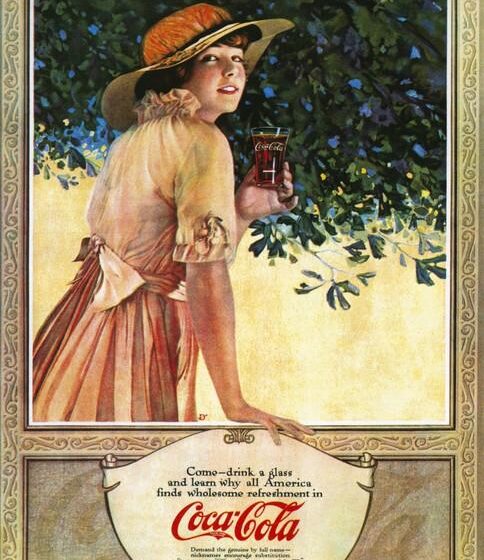

The Coca-Cola business story is one of the most interesting examples of how a small product can become a global brand. Coca-Cola started in 1886 as a pharmacy beverage in Atlanta, but its journey did not stop there. Through smart marketing, bottling, branding, and distribution, a simple drink gradually became a worldwide business.
Coca-Cola Was Not Originally a Bottled Drink
When Coca-Cola started, customers did not buy it in the familiar bottle or can we know today. It was mainly served as a fountain drink.
A glass cost 5 cents. The name “Coca-Cola” was suggested by Pemberton’s bookkeeper and partner, Frank M. Robinson, who also created the famous flowing script used for the name.
This reveals an important business idea: the product itself is not always enough. A memorable name and presentation can also become part of a product’s identity.
The First Big Business Challenge
Pemberton created the product, but he did not turn it into the global company we know today. He gradually sold interests in the business.
Later, businessman Asa G. Candler acquired the rights and helped transform Coca-Cola into a much larger business. In 1892, he founded The Coca-Cola Company.
Candler focused heavily on marketing and distribution.
Instead of simply waiting for customers to discover the drink, Coca-Cola started actively putting its name in front of people through advertising and promotional items.
An Interesting Early Marketing Strategy
Coca-Cola used coupons as early as 1887 to encourage people to try the drink.
The company also used promotional products such as calendars, clocks and fans to keep the Coca-Cola name visible to customers.
This was more than advertising.
The business was trying to make the name familiar and memorable.
The Decision That Changed Coca-Cola
One of Coca-Cola’s most important developments was bottling.
In 1894, Joseph A. Biedenharn began bottling Coca-Cola. Then, in 1899, Benjamin Thomas and Joseph Whitehead obtained the rights to bottle and sell Coca-Cola on a large scale. They helped develop a network of local bottlers.
This changed the business model.
Before bottling, customers generally had to visit a soda fountain.
With bottles, the product could travel to the customer.
That simple change created a powerful business advantage:
Instead of waiting for customers to come to the product, the product could go where the customers were.
Coca-Cola Did Not Have to Do Everything Alone
Another interesting part of Coca-Cola’s growth was its bottling network.
Rather than building every bottling operation itself, Coca-Cola developed relationships with local bottlers who could produce and distribute the drink in their territories.
This created an important business lesson:
A company can grow faster by building a strong network of partners instead of trying to control every single activity itself.
Coca-Cola Was Selling More Than a Drink
Over time, Coca-Cola built something much more valuable than a beverage.
It built a brand.
The company invested heavily in advertising and created a recognizable identity around its name and presentation. As more people saw the same brand across different locations, Coca-Cola became easier to recognize and remember.
This is where Coca-Cola’s business story becomes especially interesting.
A company can start with a physical product, but its long-term value can come from brand recognition, customer trust, distribution and repeat purchases.
What Can Businesses Learn from Coca-Cola?
An entrepreneur should not think only:
“Is my product good?”
A stronger business thinker also asks:
- How will customers discover my product?
- Why will they remember my brand?
- Where will they be able to buy it?
- Why will they buy it again?
- How can I reach more customers without doing everything myself?
Coca-Cola’s growth shows how product + branding + marketing + distribution can turn a small idea into a much larger business.
The Unknown Business Lesson
Coca-Cola’s first-year sales were only about nine drinks per day on average.
The lesson is simple:
Small sales at the beginning do not always mean a business idea is small.
Sometimes the real opportunity is hidden in how the product is marketed, distributed, positioned and remembered.
Coca-Cola’s story is therefore not just the history of a soft drink. It is the story of how a simple product gradually became a business system and a global brand.