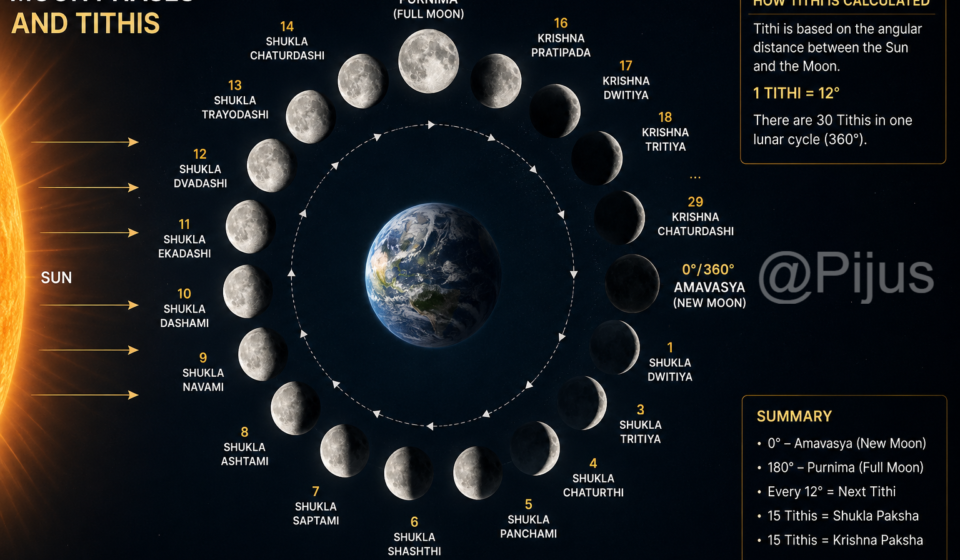

What is a Tithi? A Tithi is a traditional measurement based on the changing angular relationship between the Sun and Moon. It is used in the Hindu lunar calendar to determine dates such as Pratipada, Purnima, and Amavasya.
Unlike a normal day, a Tithi is not fixed at 24 hours. Its length depends on how quickly the angular distance between the Sun and Moon changes.
How Is a Tithi Calculated?
The complete circle around the sky is 360°. This is divided into 30 Tithis.
360° ÷ 30 = 12°
Therefore, each Tithi represents a change of approximately 12° in the angular distance between the Sun and Moon.
For example:
- 0° — Amavasya (New Moon)
- 0°–12° — Shukla Pratipada
- 12°–24° — Shukla Dwitiya
- 24°–36° — Shukla Tritiya
- 180° — Purnima (Full Moon)
- 360° — Amavasya again
This is how the lunar cycle is divided into 30 Tithis.
Why Is One Tithi Not Always 24 Hours?
The time between one New Moon and the next is about 29.53 days. Dividing this period by 30 gives an average of approximately 23 hours and 38 minutes per Tithi.
However, this is only an average.
The Moon’s orbital speed is not perfectly constant. As a result, the angular distance between the Sun and Moon can increase at different rates.
Therefore, one Tithi can be shorter than 24 hours, while another can be longer than 24 hours.
This explains why the Tithi shown in a traditional calendar can sometimes change during the same day.
How Do Purnima and Amavasya Occur?
Amavasya occurs when the Sun and Moon appear in nearly the same direction from Earth, giving an angular separation close to 0°.
As the Moon moves farther from the Sun’s apparent position, the angular separation increases.
When the separation reaches approximately 180°, we get Purnima, or the Full Moon.
After Purnima, the separation continues toward 360°, and the cycle eventually returns to Amavasya.
Shukla Paksha and Krishna Paksha
The 30 Tithis are divided into two parts.
Shukla Paksha begins after Amavasya and continues toward Purnima. During this period, the illuminated portion of the Moon visible from Earth generally increases.
Krishna Paksha begins after Purnima and continues toward the next Amavasya. During this period, the visible illuminated portion generally decreases.
The Simple Meaning of Tithi
A Tithi is not simply another name for a day.
It is a measurement based on the changing angular relationship between the Sun and Moon.
So, when you see Pratipada, Purnima, or Amavasya in a calendar, you are actually looking at a traditional timekeeping system based on the movements of celestial bodies.
The next time you check a Tithi, remember: behind that small calendar entry is the continuous movement of the Earth, Moon, and Sun.