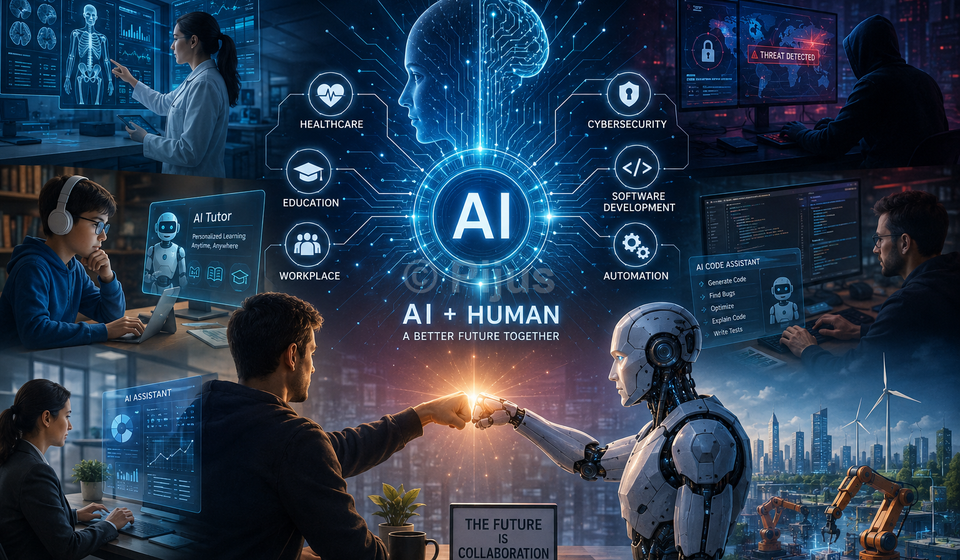

Artificial Intelligence (AI) is no longer just a concept from science-fiction movies. It has become a part of everyday life. From chatbots and AI-powered search engines to software development, healthcare, education, cybersecurity, and business automation, AI is transforming the way people work and live.
The growth of AI has been remarkably fast. Stanford’s 2026 AI Index reports that generative AI reached 53% population adoption within three years—faster than the personal computer or the internet reached comparable adoption milestones.
What Is Artificial Intelligence?
Artificial Intelligence is a technology that enables computers and software systems to perform tasks that normally require human intelligence.
These tasks include:
- Understanding language
- Recognizing images and speech
- Writing and analyzing information
- Generating images and videos
- Writing computer code
- Finding patterns in large amounts of data
- Making predictions and recommendations
- Automating complex workflows
Modern AI is moving beyond simply answering questions. AI agents are increasingly being designed to use tools, interact with software, and complete multi-step tasks with less human intervention. IBM describes this shift as a move toward AI systems and agents rather than simply focusing on individual AI models.
Why Is AI Growing So Fast?
Several factors are responsible for the rapid growth of AI.
1. Powerful Computing
Modern GPUs, cloud computing, and specialized AI chips allow companies to train and run increasingly capable AI systems.
2. Huge Amounts of Data
AI systems can learn patterns from enormous collections of text, images, audio, video, and other information.
3. Better AI Models
AI models have become much better at understanding language, reasoning, generating content, and working with multiple types of information.
4. AI Is Becoming Easier to Use
People no longer need to be AI researchers to use AI. A normal user can simply type a question or instruction and receive an answer, create an image, analyze a document, or generate computer code.
AI Is Changing the Workplace
One of the biggest effects of AI is happening in the workplace.
Companies are using AI to automate repetitive tasks, analyze information, support customers, generate content, write code, and improve productivity.
In India, AI is already becoming an important part of the IT industry. The Indian government has highlighted AI’s role in productivity, innovation, jobs, and the country’s digital economy.
However, AI does not simply mean that every human job will disappear.
Instead, many jobs are likely to change.
For example, a software tester may use AI to generate test cases, analyze failures, create automation scripts, and summarize test results. A developer can use AI coding assistants to generate initial code and then spend more time reviewing, testing, and improving it.
The important skill of the future may therefore not be AI versus humans, but humans working effectively with AI.
AI Agents: The Next Big Step
Traditional chatbots mainly respond to questions.
The next generation of AI is moving toward AI agents.
An AI agent can potentially:
- Understand a goal.
- Break the goal into smaller tasks.
- Select appropriate tools.
- Perform actions.
- Check the results.
- Continue until the task is completed.
This could transform areas such as software development, customer service, research, finance, healthcare administration, and business operations.
Gartner identifies agentic AI, domain-specific models, smaller reasoning models, and multimodal AI as important trends in the next phase of generative AI adoption.
AI and Software Development
Software development is one of the industries experiencing significant AI-driven change.
Developers can now use AI to:
- Generate code
- Explain existing code
- Find bugs
- Create unit tests
- Write documentation
- Convert code between programming languages
- Generate SQL queries
- Analyze logs
- Create prototypes
But generated code still needs human review.
AI can produce code that looks correct while containing logical errors, security problems, incorrect assumptions, or unnecessary complexity. Research on AI-assisted repositories also suggests that while generative AI can reduce some code-generation effort, it can shift work toward validation, debugging, documentation, and maintenance.
Therefore, programming fundamentals remain extremely important.
AI in Education
AI is also changing education.
Students can use AI to:
- Understand difficult concepts
- Practice programming
- Summarize lessons
- Generate questions
- Learn languages
- Receive explanations at different difficulty levels
However, students should use AI as a learning assistant rather than simply copying its answers.
The real value of education is still understanding why something works.
AI in Healthcare
AI has the potential to help healthcare professionals analyze medical information, support diagnosis, discover patterns, and accelerate research.
But healthcare is a sensitive field. AI systems must be carefully tested, validated, and monitored because incorrect information can have serious consequences.
AI should therefore support qualified professionals rather than blindly replace human judgment.
AI and Cybersecurity
AI is becoming increasingly important in cybersecurity.
Security teams can use AI to:
- Detect suspicious activity
- Analyze large volumes of logs
- Identify unusual behavior
- Prioritize security alerts
- Assist with threat intelligence
- Automate parts of incident response
At the same time, attackers can also use AI to create more sophisticated attacks.
This creates an ongoing race between attackers and defenders.
The Risks of AI
AI brings enormous opportunities, but it also creates risks.
Some important concerns include:
- Job displacement
- Fake images and videos
- Deepfakes
- Privacy problems
- Cybersecurity threats
- Misinformation
- Biased AI systems
- Overdependence on AI
- Incorrect AI-generated information
The rapid adoption of AI makes responsible development particularly important. Recent discussions around enterprise AI have also emphasized security, privacy, governance, and trustworthy deployment.
Will AI Replace Humans?
This is one of the biggest questions surrounding AI.
The answer is more complicated than simply saying “yes” or “no.”
AI is very good at certain tasks, particularly repetitive information-processing tasks. But humans still provide creativity, emotional understanding, responsibility, leadership, judgment, communication, and real-world experience.
Some jobs may disappear or shrink, while completely new roles may emerge.
The more realistic future is likely to involve significant changes in how people perform their jobs.
The Future Belongs to AI + Humans
The biggest lesson from the current AI revolution is that learning how to work with AI is becoming increasingly valuable.
Instead of asking:
“Will AI take my job?”
a better question may be:
“How can I use AI to become better at my job?”
A software engineer who understands AI tools can potentially work faster. A designer can use AI for rapid prototypes. A business owner can automate repetitive operations. A student can use AI as a personalized learning assistant.
AI is becoming another powerful tool in the technology toolbox.
Conclusion
Artificial Intelligence is growing at an extraordinary speed and is already changing technology, business, education, software development, cybersecurity, and everyday life.
The future of AI will not be determined only by how powerful the technology becomes. It will also depend on how responsibly people use it.
AI can automate tasks, increase productivity, and create new opportunities—but human judgment will remain essential.
The people who learn how to understand, use, evaluate, and work alongside AI may be among the best prepared for the next era of technology.
AI is not just changing the future. It is changing the present—and the transformation has already begun.


Hi, this is a comment.
To get started with moderating, editing, and deleting comments, please visit the Comments screen in the dashboard.
Commenter avatars come from Gravatar.