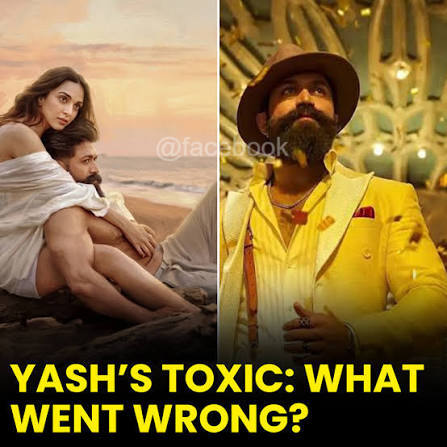

Toxic movie review raises an important question: why did Yash’s much-awaited film fail to connect with some audiences as strongly as expected? After the massive success of KGF, expectations for Toxic: A Fairy Tale for Grown-Ups were naturally high. The film offers scale, style, action and a distinctive visual world, but many viewers may feel that the emotional connection and storytelling could have been stronger.
But after watching the film, an important question remains:
What went wrong?
Was the problem with Yash? Or did the film focus too much on style and not enough on the emotions that make audiences love a character?
The answer may be a combination of several things.
A Great Movie Needs More Than a Big Star
A popular actor can bring people into theatres, but a story is what makes them stay emotionally connected.
KGF worked for many viewers because Rocky was not simply a powerful man. Audiences saw his ambition, his struggles, his anger, his relationships and his desire to change his life.
That emotional journey made Rocky memorable.
With Toxic, many viewers may feel that the style and visual presentation are stronger than the emotional connection with the characters.
And that creates a problem.
People can admire a movie without necessarily loving it.
Where Could Toxic Have Been Better?
1. The Story Needed a Stronger Emotional Heart
The audience wants to understand the person behind the hero.
Why does he behave this way?
What does he fear?
What has he lost?
Who does he love?
What is he willing to sacrifice?
These questions create emotional attachment.
If Toxic had placed even more emphasis on these human emotions, the audience could have felt closer to the protagonist.
2. Yash Needed a Deeper Character Journey
Yash’s biggest strength is not only action.
It is his screen presence.
When he enters a scene, audiences naturally pay attention. But that power becomes even more effective when the character has emotional depth.
Instead of showing only how powerful the hero is, the story could have shown why he became that person.
A powerful man with a vulnerable side is usually more interesting than a powerful man who simply wins.
Action Is Better When It Has Meaning
Audiences love action—but action becomes unforgettable when there is an emotional reason behind it.
Imagine two characters fighting.
In the first version, they fight because the story needs an action scene.
In the second version, one character is fighting to protect someone he loves, take revenge for something deeply personal, or overcome a fear that has controlled his life.
The second fight will naturally feel more important.
Action creates excitement. Emotion creates impact.
A better balance between the two could have made Toxic more satisfying.
The Villain Also Matters
A great hero needs a memorable opponent.
The best villains are not simply people who want to stop the hero. They have their own beliefs, ambitions, fears and reasons.
If the audience understands the villain—even if they hate him—the conflict becomes much more interesting.
A stronger hero-villain relationship could have given Toxic another powerful layer.
Could the Movie Have Been Shorter?
A long movie is not automatically a bad movie.
The real question is:
Does every scene deserve to be there?
If a scene develops the character, moves the story forward or creates an emotional reaction, the audience usually accepts the runtime.
But when scenes feel repetitive or disconnected from the main story, even a great visual experience can begin to feel slow.
Better pacing and tighter editing could have increased the impact.
Why Do Some Other Movies Stay in Our Hearts?
Think about the movies people continue discussing years after watching them.
Often, it is not because of the biggest explosion or the most expensive set.
It is because something in the story feels human.
Love.
Family.
Friendship.
Betrayal.
Ambition.
Fear.
Loss.
Hope.
The desire to become somebody.
These are emotions that almost everyone understands.
Even when a movie is fictional or completely unrealistic, audiences can still connect with it if the emotions feel real.
What Could Have Made Toxic More Loved?
The film could potentially have been stronger with:
- A deeper emotional relationship at the centre of the story
- More character development instead of relying mainly on power and style
- A stronger personal reason behind the action
- A more memorable and complex villain
- Tighter pacing and editing
- More moments of vulnerability
- A clearer emotional journey from beginning to end
Most importantly, the movie needed to make audiences feel something beyond excitement.
The Real Lesson From Toxic
Calling a movie simply “bad” does not explain why audiences were disappointed.
The more interesting question is:
“How could a movie with so much potential have been even better?”
Toxic had a major star, ambition, scale, action and a distinctive visual identity.
But a movie becomes big through its scale.
A movie becomes loved through its people and its emotions.
That may be the biggest difference.
Yash does not necessarily need another KGF.
He needs a character that gives him the opportunity to show power, vulnerability, love, pain, fear and ambition at the same time.
Because when a superstar gets a great story and a deeply human character, audiences don’t just watch the movie.
They remember it.