Skip to content
-
Subscribe to our newsletter & never miss our best posts. Subscribe Now!
  • https://www.facebook.com/
  • https://twitter.com/
  • https://t.me/
  • https://www.instagram.com/
  • https://youtube.com/
Pijus

Exploring technology, education, business, travel, sports, nature, and the stories that inspire us.

Pijus

Exploring technology, education, business, travel, sports, nature, and the stories that inspire us.

  • Home
  • Health
  • Education
  • Technology
  • Business
  • World
  • Explore
  • Sports
  • Entertainment

Recent Posts

  • WHO Typhoid Vaccine Guidance 2026: Parents Guide
  • Messi Retirement 2026: Final Goodbye
  • AI Cybercrime and Account Takeover: How Hackers Exploit AI Security
  • Rap as a Voice of Protest: From Hip-Hop to Tilottama
  • Duleep Trophy 2026: Unknown Facts, History & Latest Updates
  • Home
  • Health
  • Education
  • Technology
  • Business
  • World
  • Explore
  • Sports
  • Entertainment
Subscribe
Close

Search

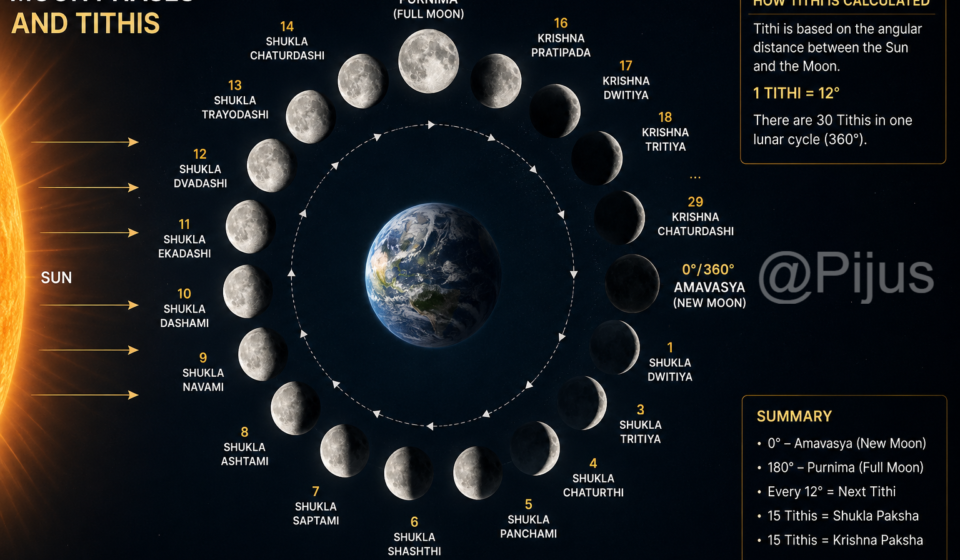
Moon phases and Tithis showing how the Sun and Moon determine Purnima and Amavasya
Explore

What Is a Tithi? How Tithi Is Calculated by the Sun and Moon

By admin
August 30, 2026 2 Min Read
0

What is a Tithi? A Tithi is a traditional measurement based on the changing angular relationship between the Sun and Moon. It is used in the Hindu lunar calendar to determine dates such as Pratipada, Purnima, and Amavasya.

Unlike a normal day, a Tithi is not fixed at 24 hours. Its length depends on how quickly the angular distance between the Sun and Moon changes.

How Is a Tithi Calculated?

The complete circle around the sky is 360°. This is divided into 30 Tithis.

360° ÷ 30 = 12°

Therefore, each Tithi represents a change of approximately 12° in the angular distance between the Sun and Moon.

For example:

  • 0° — Amavasya (New Moon)
  • 0°–12° — Shukla Pratipada
  • 12°–24° — Shukla Dwitiya
  • 24°–36° — Shukla Tritiya
  • 180° — Purnima (Full Moon)
  • 360° — Amavasya again

This is how the lunar cycle is divided into 30 Tithis.

Why Is One Tithi Not Always 24 Hours?

The time between one New Moon and the next is about 29.53 days. Dividing this period by 30 gives an average of approximately 23 hours and 38 minutes per Tithi.

However, this is only an average.

The Moon’s orbital speed is not perfectly constant. As a result, the angular distance between the Sun and Moon can increase at different rates.

Therefore, one Tithi can be shorter than 24 hours, while another can be longer than 24 hours.

This explains why the Tithi shown in a traditional calendar can sometimes change during the same day.

How Do Purnima and Amavasya Occur?

Amavasya occurs when the Sun and Moon appear in nearly the same direction from Earth, giving an angular separation close to 0°.

As the Moon moves farther from the Sun’s apparent position, the angular separation increases.

When the separation reaches approximately 180°, we get Purnima, or the Full Moon.

After Purnima, the separation continues toward 360°, and the cycle eventually returns to Amavasya.

Shukla Paksha and Krishna Paksha

The 30 Tithis are divided into two parts.

Shukla Paksha begins after Amavasya and continues toward Purnima. During this period, the illuminated portion of the Moon visible from Earth generally increases.

Krishna Paksha begins after Purnima and continues toward the next Amavasya. During this period, the visible illuminated portion generally decreases.

The Simple Meaning of Tithi

A Tithi is not simply another name for a day.

It is a measurement based on the changing angular relationship between the Sun and Moon.

So, when you see Pratipada, Purnima, or Amavasya in a calendar, you are actually looking at a traditional timekeeping system based on the movements of celestial bodies.

The next time you check a Tithi, remember: behind that small calendar entry is the continuous movement of the Earth, Moon, and Sun.


Author

admin

Follow Me
Other Articles
How the internet works from Wi-Fi router to ISP and Google data center
Previous

How the Internet Works, Wi-Fi Router to Google Server

20 fruits you should and shouldn’t eat together
Next

🍎 20 Fruits You Should and Shouldn’t Eat Together

No Comment! Be the first one.

    Leave a Reply Cancel reply

    Your email address will not be published. Required fields are marked *

    Search

    Latest Posts

    • WHO Typhoid Vaccine Guidance 2026: Parents Guide
    • Messi Retirement 2026: Final Goodbye
    • AI Cybercrime and Account Takeover: How Hackers Exploit AI Security
    • Rap as a Voice of Protest: From Hip-Hop to Tilottama
    • Duleep Trophy 2026: Unknown Facts, History & Latest Updates

    About This Site

    Welcome to pijus.in — a personal space where ideas, knowledge, technology, education, current topics, travel, nature, and everyday life come together.

    This website is created to share simple, useful, and interesting content that people can learn from and enjoy. From technology and education to society, nature, health awareness, entertainment, and inspiring stories, the goal is to make every article informative, easy to understand, and worth reading.

    I believe good content does not always need to be complicated. Sometimes, a simple explanation can make a difficult topic easier to understand.

    Pijus.in is my growing digital space — a place to learn, explore, share ideas, and discover something new.

    Thank you for visiting and being part of this journey.

    Recent Posts

    • WHO Typhoid Vaccine Guidance 2026: Parents Guide
    • Messi Retirement 2026: Final Goodbye
    • AI Cybercrime and Account Takeover: How Hackers Exploit AI Security
    • Rap as a Voice of Protest: From Hip-Hop to Tilottama
    • Duleep Trophy 2026: Unknown Facts, History & Latest Updates
    September 2026
    M T W T F S S
     123456
    78910111213
    14151617181920
    21222324252627
    282930  
    « Aug    

    Find Us

    Address
    Kolkata-700090
    West Bengal
    India

    Hours
    Monday–Friday: 9:00AM–5:00PM
    Saturday & Sunday: 11:00AM–3:00PM

    Copyright 2026 — Pijus. All rights reserved.