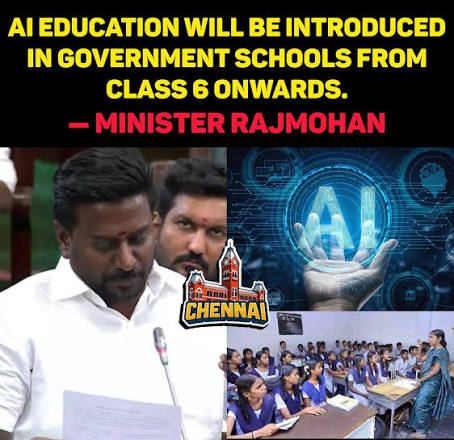

New education reforms aim to make students future-ready through AI, analytical thinking, entrepreneurship and personalised learning
Chennai, August 2026: Tamil Nadu is planning a major shift in the way government-school students learn. Instead of focusing only on marks and traditional examinations, the state is introducing AI-powered personalised learning, analytical thinking, problem-solving, entrepreneurship and emerging technology skills.
One of the most notable changes is the decision to move away from describing students as “slow learners.” Tamil Nadu School Education Minister A. Rajmohan said the education system should focus more on how each student learns and on improving student well-being.
AI Will Help Students Learn at Their Own Pace
Under the proposed Personalised Adaptive Learning (PAL) programme, Classes 6 to 8 students in 500 government middle schools will initially participate.
After each chapter, students will take an AI-designed assessment. The system can identify concepts where a student needs additional help and provide more practice.
Importantly, the programme will follow a hybrid model, meaning teachers will continue to play an important role alongside the technology. The pilot has an allocation of ₹70 lakh.
From Marks to Analytical Thinking
Tamil Nadu also plans to introduce the TN-Arivu curriculum across schools from the 2027–28 academic year.
The programme will focus on:
- Analytical and logical thinking
- Problem-solving
- Innovation
- Entrepreneurship
- Life and employment-oriented skills
- AI and emerging technologies
The curriculum is planned in stages, from Arivu Foundation for Classes 1–5 to Arivu Discovery for Classes 6–8 and Arivu Edge for Classes 9–12.
Why “Slow Learner” Should Not Define a Student
A student who needs more time to understand mathematics, science or language is not necessarily less capable.
The new approach reflects a simple idea: students do not all learn at the same speed or in the same way.
This is particularly important because traditional tests may not always show exactly which concepts a student has understood and which areas require more practice. AI-based personalised learning could help identify those gaps earlier.
AI and Robotics Are Also Entering Classrooms
Tamil Nadu is also expanding its TN Spark initiative, which introduces AI and robotics to government-school students.
The programme is planned in stages, with foundational learning for Classes 6–8, intermediate learning for Classes 9–10 and elective options related to AI, robotics and virtual reality for Classes 11–12. Teacher training is also part of the plan.
What This Means for the Next Generation
This reform could signal a larger change in education: the future student may need more than the ability to memorise answers.
Knowing how to analyse information, solve unfamiliar problems, understand technology, create new ideas and adapt to changing careers could become increasingly important.
For today’s students, the message is powerful:
A low mark does not have to become a lifelong label. Learning can be personalised, skills can be developed, and every student can progress at their own pace.
Tamil Nadu’s latest plans show how education may gradually move from simply asking “How many marks did you get?” to asking “What can you understand, create and solve?”