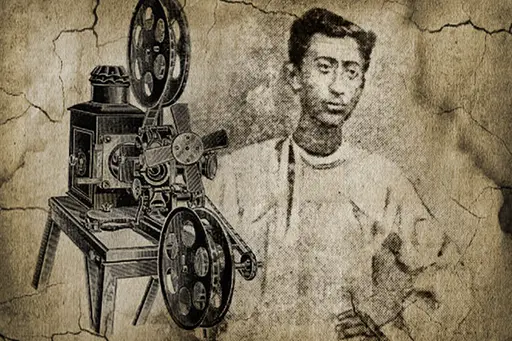

When people talk about the beginning of Indian cinema, names like Dadasaheb Phalke usually come first. However, decades before modern Bollywood became famous, another filmmaker was experimenting with moving pictures in Kolkata.
His name was Hiralal Sen.
He filmed theatre performances, created advertising films and documented political events. Moreover, he was working with cinema when the medium itself was still very new. Yet today, there is an extraordinary problem: almost none of his films survive.
Who Was Hiralal Sen?
Hiralal Sen was a Bengali photographer and filmmaker who became interested in motion pictures in the late 1890s.
In 1898, he watched a film presentation associated with the stage production The Flower of Persia at Kolkata’s Star Theatre. The new technology fascinated him. Soon afterward, he got an opportunity to use a camera and filmed scenes from the theatrical production. This became one of the earliest steps in his filmmaking career.
As a result, Sen was no longer simply watching foreign films. He was beginning to create moving images himself.
Later, he and his brother Motilal Sen established the Royal Bioscope Company. The company became an important early film enterprise in Bengal.
His Films Were Connected to Theatre
Kolkata already had a strong theatre culture. Therefore, it was natural for Sen to use the stage as inspiration for his early films.
Between approximately 1901 and 1904, he filmed scenes from productions associated with the Classic Theatre. These included Bhramar, Hariraj and Buddhadev.
One of his most notable productions was Alibaba and the Forty Thieves, made in 1903 from a Classic Theatre production.
This connection reveals something fascinating about early Bengali cinema.
Cinema did not suddenly replace theatre. Instead, early cinema grew partly from the existing theatre culture.
Stage performances provided actors, stories and dramatic scenes that could be transferred to the new medium of film.
He Was Making Film Advertisements Too
Perhaps the most surprising part of Hiralal Sen’s story is his understanding of the commercial power of cinema.
Sen produced advertising films for products including Jabakusum Hair Oil and Edwards Tonic. Historical accounts commonly describe these works as among the earliest Indian examples of film advertising.
Think about how early this was.
Today, companies use YouTube videos, Instagram Reels and television commercials to promote products. Similarly, Sen was experimenting with moving pictures as a marketing tool more than a century ago.
Therefore, his work was not limited to entertainment. He was already exploring the commercial possibilities of cinema.
He Also Filmed Political Events
Sen’s camera was not restricted to theatre and advertising.
In 1905, he filmed events connected with the Anti-Partition and Swadeshi movement at Kolkata’s Town Hall. The footage is often described as one of India’s earliest examples of political filmmaking.
This was significant because cinema could now serve another purpose.
Instead of simply entertaining audiences, a camera could record events and preserve moments of public history.
Consequently, Sen’s work covered several areas that remain important to filmmaking today: entertainment, advertising, news and politics.
Then His Films Disappeared
This is the most tragic part of Hiralal Sen’s story.
The Royal Bioscope eventually declined, and its production activities ended in 1913. A few years later, however, disaster struck.
In 1917, a fire at the Raibagan house destroyed the collection of Hiralal Sen’s films. Historical accounts describe the incident as the loss of a major collection of his cinematic work.
As a result, modern audiences cannot simply watch most of the films that established Sen as an early pioneer.
Instead, researchers have to depend on historical records, newspaper reports, photographs and written descriptions to understand his work.
The loss is especially frustrating because these films could have shown us what early Kolkata theatre and filmmaking actually looked like.
Imagine If His Films Had Survived
Imagine being able to watch Kolkata’s theatre performances from more than a century ago.
We could see how early Indian actors performed for a camera. We could examine one of India’s earliest film advertisements. We might even see historical political events through the eyes of a filmmaker who witnessed them.
Unfortunately, that visual record is largely gone.
The fire therefore did more than destroy old film reels. It erased a valuable part of India’s early visual history.
Why Hiralal Sen Still Matters
Hiralal Sen’s importance goes beyond being an early filmmaker.
He experimented with several forms of cinema at a remarkably early stage:
- Theatre films
- Advertising films
- Political films
- News and documentary-style footage
Furthermore, his career demonstrates how quickly Kolkata’s artistic culture adapted to the new technology of moving pictures.
The city already had theatre, literature, photography and music. Cinema brought these creative traditions together in a completely new way.
A Forgotten Chapter of Indian Cinema
Today, Hiralal Sen is far less famous than many later Indian filmmakers. Nevertheless, his story deserves attention.
He understood the possibilities of cinema when the technology was still in its infancy. He filmed theatre, experimented with advertising and documented political events. Yet most of the visual evidence of his work disappeared in a devastating fire.
That is what makes his story so unusual.
We know that these films existed, but we can no longer watch most of them.
Hiralal Sen therefore remains one of the fascinating forgotten pioneers of Indian cinema—a filmmaker whose work helped shape the medium, even though much of that work was lost before later generations could see it.
Read Next
Before Bollywood: How Indian Cinema Really Started
Raja Harishchandra: The Story Behind India’s First Indian Feature Film
How Kolkata Became an Early Centre of Indian Cinema
7 Forgotten Pioneers Who Shaped Indian Cinema