
Who invented chess? Was it a king, a military strategist, a mathematician, or an unknown genius from ancient India?
The answer may surprise you. No historically proven individual can claim to be the inventor of chess. Instead, historians generally connect the game’s earliest known ancestor with an ancient Indian strategy game called Chaturanga.
From India, the game travelled across Persia and the Islamic world before reaching Europe. Along the way, players changed its pieces, rules, terminology, and style of play.
The result became the modern chess game played around the world today.
Where Did Chess Originate?
The earliest widely accepted ancestor of chess emerged in India around the 6th century CE.
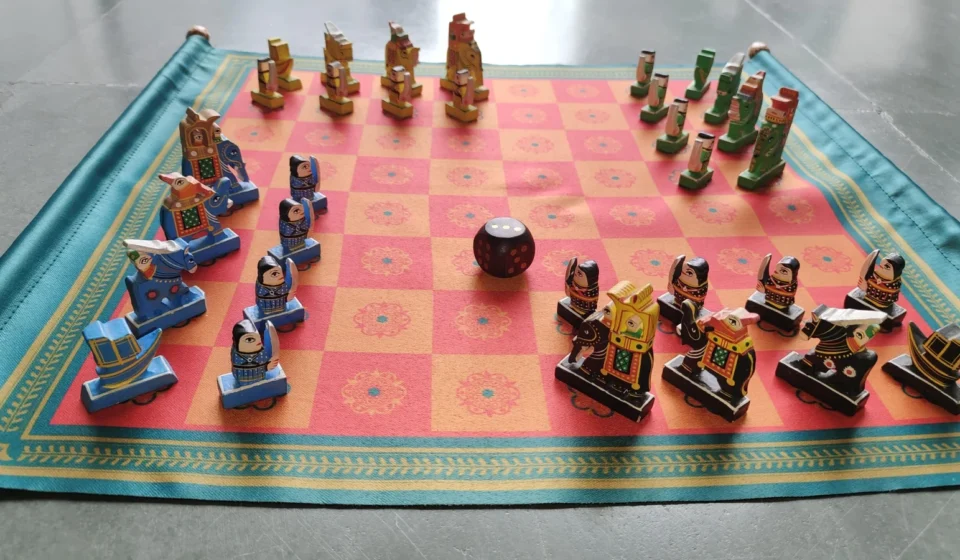
Ancient players knew this game as Chaturanga. The name relates to the four divisions of an army:
- Infantry
- Cavalry
- Elephants
- Chariots
Those military divisions eventually became associated with the ancestors of several modern chess pieces.
Therefore, the history of chess begins not with a single inventor, but with a game that represented the strategy of an ancient battlefield.
What Was Chaturanga?
Imagine an ancient army preparing for battle.
Soldiers stand in formation. Cavalry waits for an opportunity to attack. Elephants provide powerful support, while chariots move across the battlefield.
Now imagine turning that entire military system into a board game.
That idea captures the basic concept behind Chaturanga.
Players controlled different types of pieces, each with its own movement and strategic purpose. As a result, success depended on planning rather than luck.
The game therefore created a miniature battlefield where two players could test their strategic thinking.
Who Actually Created Chess?
This remains one of the biggest mysteries in chess history.
Unfortunately, no reliable historical record identifies the person who created Chaturanga.
Ancient games rarely have a clearly documented inventor. Instead, people often change rules gradually over generations. One group might introduce a new movement, while another culture could modify the pieces or objective.
Consequently, modern chess probably developed through a long process rather than appearing suddenly from one person’s idea.
So, when someone asks “Who invented chess?”, the most accurate answer is:
We don’t know the individual inventor, but the game’s earliest widely accepted ancestor developed in ancient India.
Did Sissa Invent Chess?
You may have heard the famous story of Sissa, a legendary Indian figure who supposedly invented chess for a king.
According to the story, the king offered Sissa any reward he wanted. Instead of requesting gold or land, Sissa asked for grains of rice.
He wanted one grain for the first square, two for the second, four for the third, and so on across all 64 squares.
Because the number doubles after every square, the final amount becomes enormous.
It is a brilliant mathematical story. However, historians do not have reliable evidence proving that Sissa actually invented chess.
Therefore, treat the Sissa story as a fascinating legend rather than established historical fact.
Why Was Chess Created?
Nobody knows exactly why the first version of Chaturanga appeared.
Nevertheless, its military structure provides an important clue.
Different pieces represented different parts of an army. Players had to position those forces carefully, protect important pieces, anticipate attacks, and plan several moves ahead.
In other words, Chaturanga transformed military strategy into an intellectual competition.
Instead of fighting on a real battlefield, two players could compete through:
Planning → Positioning → Attack → Defence → Calculation
That basic idea still defines chess today.
How Did Chess Travel From India to Persia?
Chess did not remain within India.
Over time, the game travelled westward and reached Persia, where it developed into a form known as Chatrang and later Shatranj.
This stage represents a major turning point in chess history.
Persian players adopted the game and developed their own traditions around it. Meanwhile, Persian terminology also influenced the language we associate with chess today.
From Persia, the game continued spreading throughout the Islamic world.
As a result, chess became an important intellectual and recreational activity across a much larger region.
What Does Checkmate Mean?
One of the most interesting chess words has a Persian connection.
The expression shāh māt is associated with the king being defeated or unable to escape.
The Persian word shāh means king.
Over centuries, this terminology travelled through different languages and eventually contributed to the word checkmate.
So, every time a player announces checkmate, they are using a word with a connection to the ancient Persian chapter of chess history.
The Chess Pieces Were Once Very Different
Modern chess pieces look familiar to billions of players.
However, their ancestors could look and move very differently.
This becomes especially interesting when you examine the bishop, rook, queen, and knight.
🐘 The Bishop Was Once an Elephant
The predecessor of the modern bishop represented an elephant in earlier forms of chess.
In Arabic terminology, the piece became known as al-fil, meaning elephant.
Its movement also differed from the modern bishop.
Eventually, European chess transformed the piece into the diagonal-moving bishop that we recognize today.
🐎 The Knight Represents Cavalry
The knight has retained one of the clearest connections with its ancient military origin.
The horse represents cavalry, which played an important role in ancient warfare.
Its movement also makes the knight unique. Unlike other pieces, it can jump over pieces on the board.
That unusual ability has survived through many centuries of chess evolution.
🏰 The Rook Has a Chariot Connection
The modern rook also carries an ancient military connection.
Its earlier form was associated with a chariot, while the Persian term rukh influenced its later development.
Today, players often imagine a castle when they see a rook.
However, the piece’s historical journey began much earlier.
The Queen Was Once Surprisingly Weak
Here is one of the most surprising facts about chess.
The queen was not always the strongest piece on the board.
Earlier versions of chess used a royal adviser or vizier instead of today’s powerful queen. That piece had considerably less freedom of movement.
Later, European chess underwent major changes.
The queen gained dramatically greater mobility and became the strongest piece in the game.
As a result, one of the most important pieces in modern chess has a surprisingly different history from what its name suggests.
When Did Modern Chess Appear?
Ancient Indian Chaturanga was not identical to modern chess.
The rules changed as the game moved between cultures. Persian Shatranj used different piece movements, while European players later introduced further changes.
During the late medieval period and around the 15th century, several major rule changes transformed European chess.
The queen became far more powerful. The bishop also gained its modern long-range diagonal movement.
Consequently, games became faster, more tactical, and closer to the chess we recognize today.
How Chess Evolved Across the World
The entire journey can be summarized simply:
🇮🇳 Ancient India — Chaturanga
A military-themed strategy game associated with the four divisions of an army.
⬇️
🇮🇷 Persia — Chatrang / Shatranj
Persian players adopted the game and developed new traditions and terminology.
⬇️
🌙 Islamic World — Shatranj Spreads
The game travelled across a large part of the Islamic world and became an important intellectual pastime.
⬇️
🇪🇺 Europe — Major Rule Changes
European players transformed several pieces and made the game much faster.
⬇️
♟️ Modern Chess
The game gradually developed into the internationally recognized form played today.
Was Chess Originally a War Game?
The military connection is extremely strong, but historians should still avoid claiming more than the evidence proves.
Chaturanga represented different military forces, and its name itself relates to the four divisions of an army.
Therefore, it is reasonable to describe it as a military-themed strategy game.
However, we cannot confidently identify the exact intention of its original creator.
That distinction matters because chess history contains both documented evidence and later legends.
Why Did the Queen Become So Powerful?
The queen’s transformation changed chess dramatically.
Originally, the royal adviser could move only a limited distance. Players therefore had fewer opportunities for rapid attacks.
Later European rule changes gave the queen extraordinary range.
Suddenly, the piece could move across rows, columns, and diagonals.
As a result, attacks became much faster and combinations became more complicated.
This change helped create the dynamic style of chess familiar to modern players.
The Biggest Mystery in Chess History
Perhaps the most fascinating question is also the simplest:
Who made the first chess move?
History cannot give us a definite name.
We know that Chaturanga developed in ancient India. We know that the game later travelled to Persia and the Islamic world. We also know that European players eventually transformed its rules.
Yet the identity of the person who created the earliest version remains unknown.
That mystery makes chess history even more fascinating.
From an Ancient Battlefield to a Global Game
Chess has travelled an extraordinary distance.
Its journey began with an ancient Indian strategy game and continued through Persian and Islamic cultures before reaching Europe.
Along the way, the pieces changed. The rules changed. Even the meaning of several pieces changed.
Nevertheless, the central idea remained remarkably simple:
Two players. One board. One battle of strategy.
More than a thousand years later, millions of people still sit across from an opponent and ask the same question:
What should I move next?
That simple question connects modern players with one of the oldest strategic games in human history.
Frequently Asked Questions About Chess History
Who invented chess?
No historically confirmed individual invented chess. Historians generally connect its earliest widely accepted ancestor, Chaturanga, with ancient India around the 6th century CE.
Where did chess originate?
The earliest widely accepted ancestor of chess originated in India. The game later travelled to Persia, the Islamic world, and Europe.
When was chess invented?
Chaturanga appeared around the 6th century CE, although historians cannot identify its exact invention date.
What was chess originally called?
One of the earliest known ancestors was called Chaturanga. After reaching Persia, the game developed into Chatrang and later Shatranj.
What does Chaturanga mean?
Chaturanga refers to the four divisions of an army: infantry, cavalry, elephants, and chariots.
Did Sissa really invent chess?
The Sissa story is a famous legend. However, reliable historical evidence does not establish Sissa as the actual inventor of chess.
Where did the word checkmate come from?
The word has a historical connection with the Persian expression shāh māt, associated with the defeat or helplessness of the king.
Was the queen always the strongest chess piece?
No. The queen’s predecessor had limited movement. European rule changes later transformed the piece into the powerful queen used today.
Was the bishop originally an elephant?
Yes. Earlier forms of chess used an elephant-related piece. The modern bishop developed from this older piece through the game’s evolution.
Final Thought
Chess may look like a simple game played on 64 squares.
However, its history tells a much bigger story.
The game connects ancient India, Persia, the Islamic world, and medieval Europe. Each culture contributed to its evolution, changing the pieces and rules along the way.
Nobody knows the name of the person who made the first chess move.
Perhaps that is the most fascinating part.
The inventor disappeared, but the game survived.
Today, whenever a knight jumps, a rook attacks, or a king faces checkmate, players are continuing a tradition that began more than a thousand years ago.
The chessboard is not merely a game board. It is a surviving piece of history.